Table Number Co · buyer guide
Which host-stand sign construction fits your restaurant entrance?
Choose a Table Number Co host-stand sign by where guests first look and how the display will be supported. For worldwide orders, specify a countertop base, separate floor stand or wall mounting before choosing the face material. A sign face alone does not establish the footprint, height or hardware of the finished display.
Reviewed 2026-09-05 · AI-assisted editorial review. General buying guidance; illustrative scenarios are not customer case studies. Images are AI-generated concepts.
Start with one job: tell arriving diners where to check in. A welcome logo that sits behind the host serves a different viewing position from a freestanding instruction at the entrance. Sketch the guest approach and the host’s working area on the same page. This gives the maker something more useful than a cropped inspiration photograph.
Treat the welcome face, support and replaceable information as separate choices. You might want a permanent restaurant name with a removable private-event card. That request does not necessarily call for an entire interchangeable sign. Identifying the small part that changes can keep the object visually simple while leaving the host a practical way to update it.
Is a countertop sign or a floor stand a better fit?
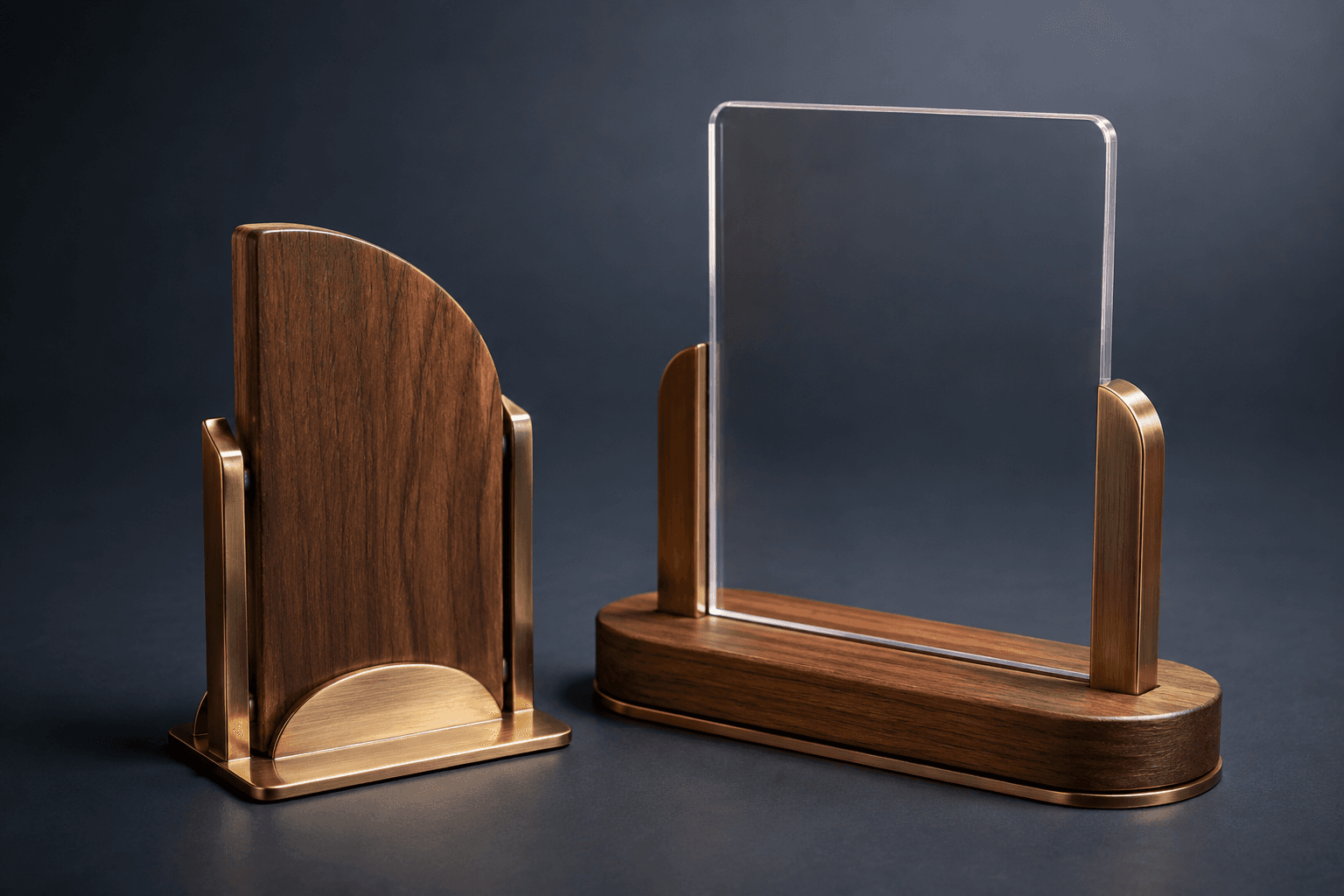
Choose a countertop sign when the host station already sits in the guest’s line of sight and has room for the complete base. Consider a floor stand when the instruction must appear before guests reach the desk. Compare their full occupied space, including the support behind or below the visible message.
Measure a countertop display against the actual work surface, with the booking device, menus and whatever else normally stays there. A narrow face can still have a deep base. Ask for the assembled width, depth and height rather than using the artwork rectangle as the product measurement. Include a side view in the brief if the sign will sit close to the counter edge.
For a floor display, mark the proposed base position on the venue plan and have the responsible venue contact review it. A photograph taken with the entrance empty can hide how the spot is used during service. This guide helps describe the purchase; the venue must decide whether the proposed placement suits its actual circulation and access requirements.
What should the sign holder specification include?
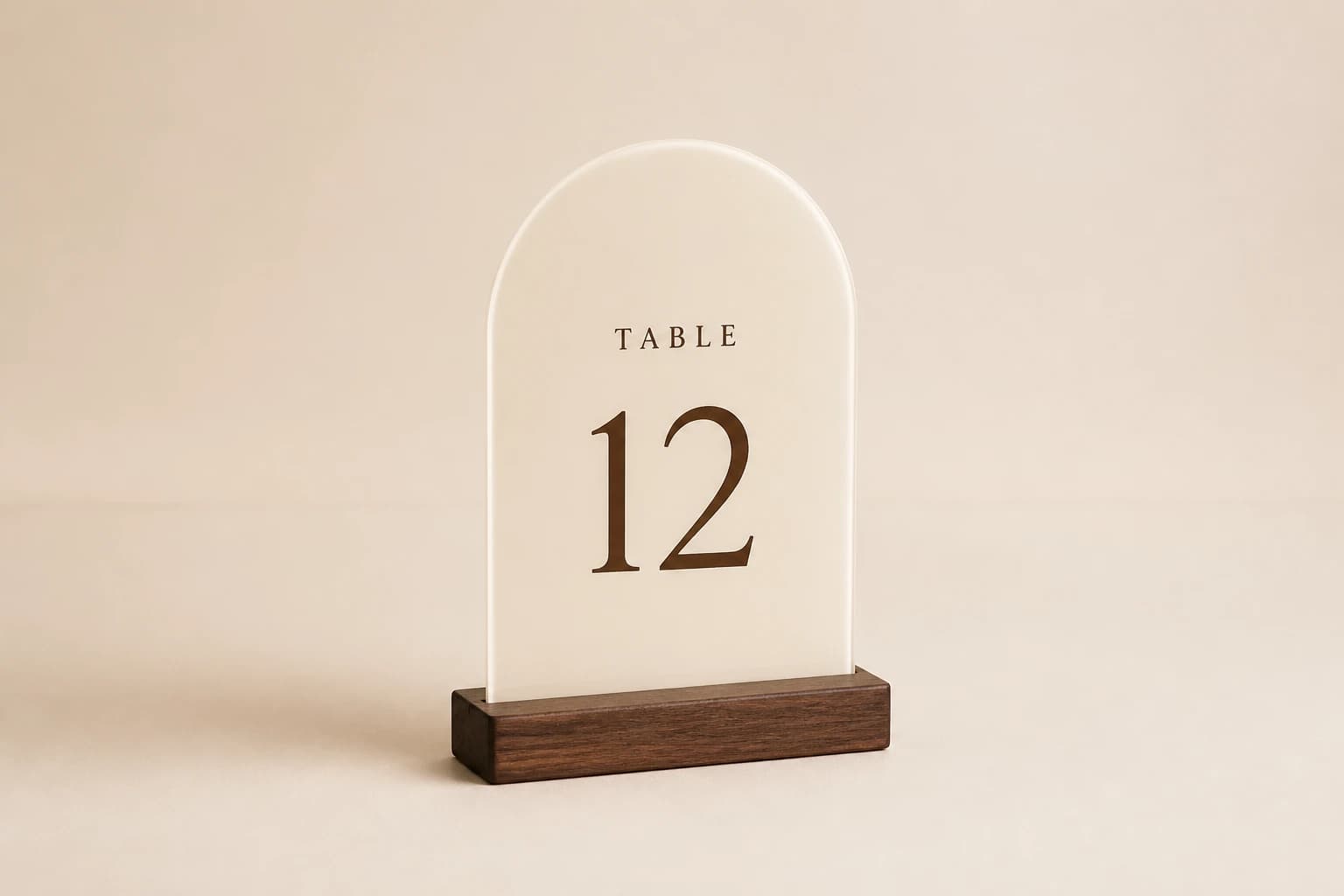
A sign-holder specification should identify how the face is retained, how an insert is changed and what holds the assembly upright. Ask whether the quoted item includes the face, base, pole, lenses and graphics. Those details matter more than a general description such as an acrylic welcome sign or metal display.
Displays2Go’s telescoping holder is one concrete example of a top-loading, double-sided frame with protective PVC lenses and an adjustable pole. That construction shows why a buyer should distinguish the graphic from the surrounding assembly. It is a reference format, not the specification of a Table Number Co product or evidence that its parts will interchange with another holder.
Ask the maker to show the proposed joining method on the drawing. A removable panel in a slot, a permanently attached face and a framed insert create different update tasks. If a component can be removed, identify which component it is and whether the quoted replacement arrives ready to use. Do not assume an empty frame includes printing simply because the product photograph contains a message.
Sources: Displays2Go: Telescoping Sign Holder with Adjustable Pole and Steel Base
Should the host sign be opaque or transparent?
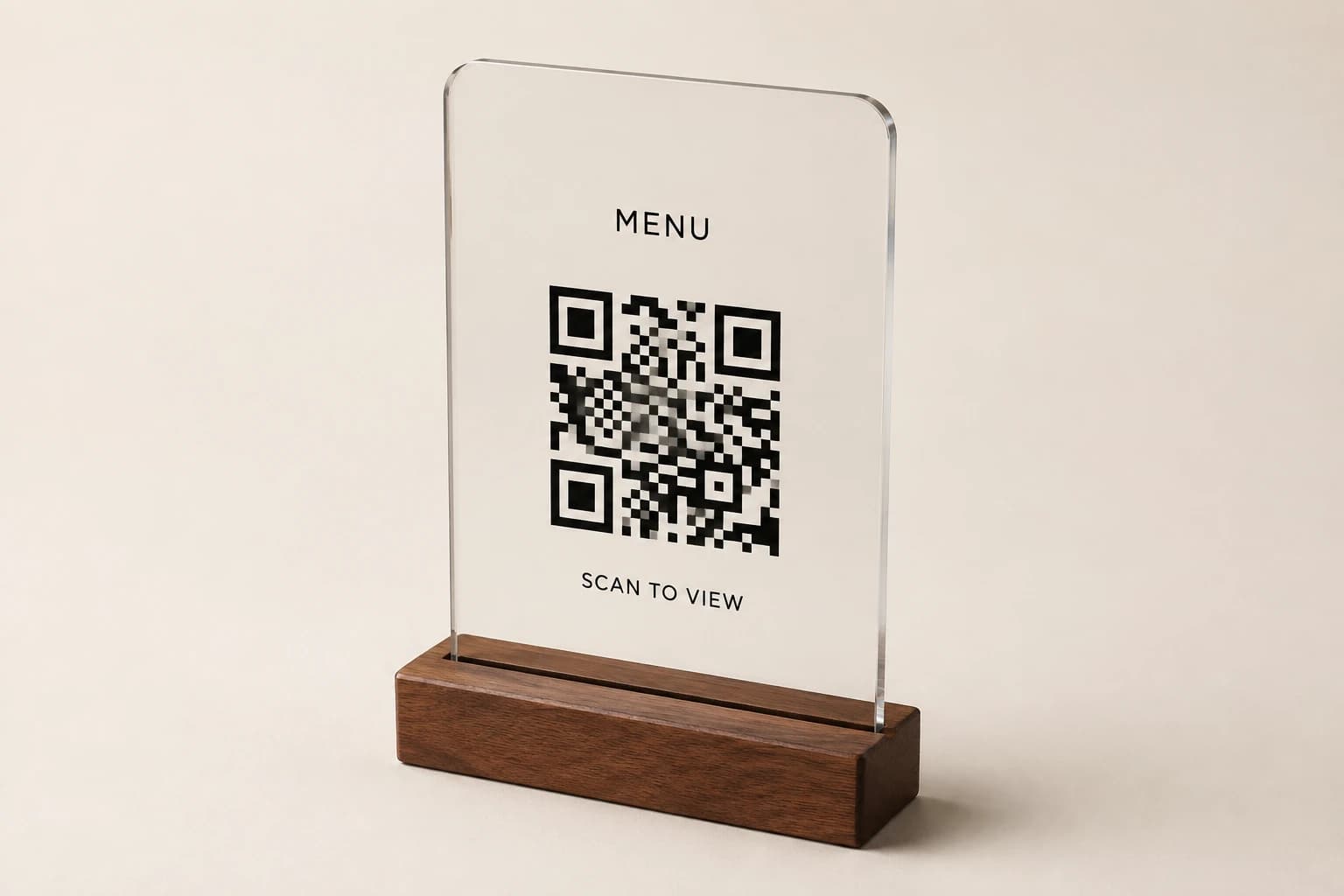
Choose an opaque face when the welcome message needs its own controlled background. Choose a transparent face only after checking what guests will see through it from the intended approach. The host desk, nearby fixtures and changing activity become part of that view, so approve the face against the real setting.
A clear panel can work well with a restrained logo, but a pale logo on a busy background deserves a physical sample or a realistic placement mockup. Ask whether the proposal includes a white backing layer, a separate backer or another method of separating the lettering from the background. These are construction choices with visible effects, not merely file export settings.
Keep the test focused on the instruction. Put the proposed wording at the proposed size in the entrance view, then decide whether decorative details compete with it. The goal is not to fill every available part of the panel. If the design needs a patterned border, leave a clearly defined area for the message rather than placing essential words over the most active artwork.
How should private-event messages fit a permanent welcome sign?
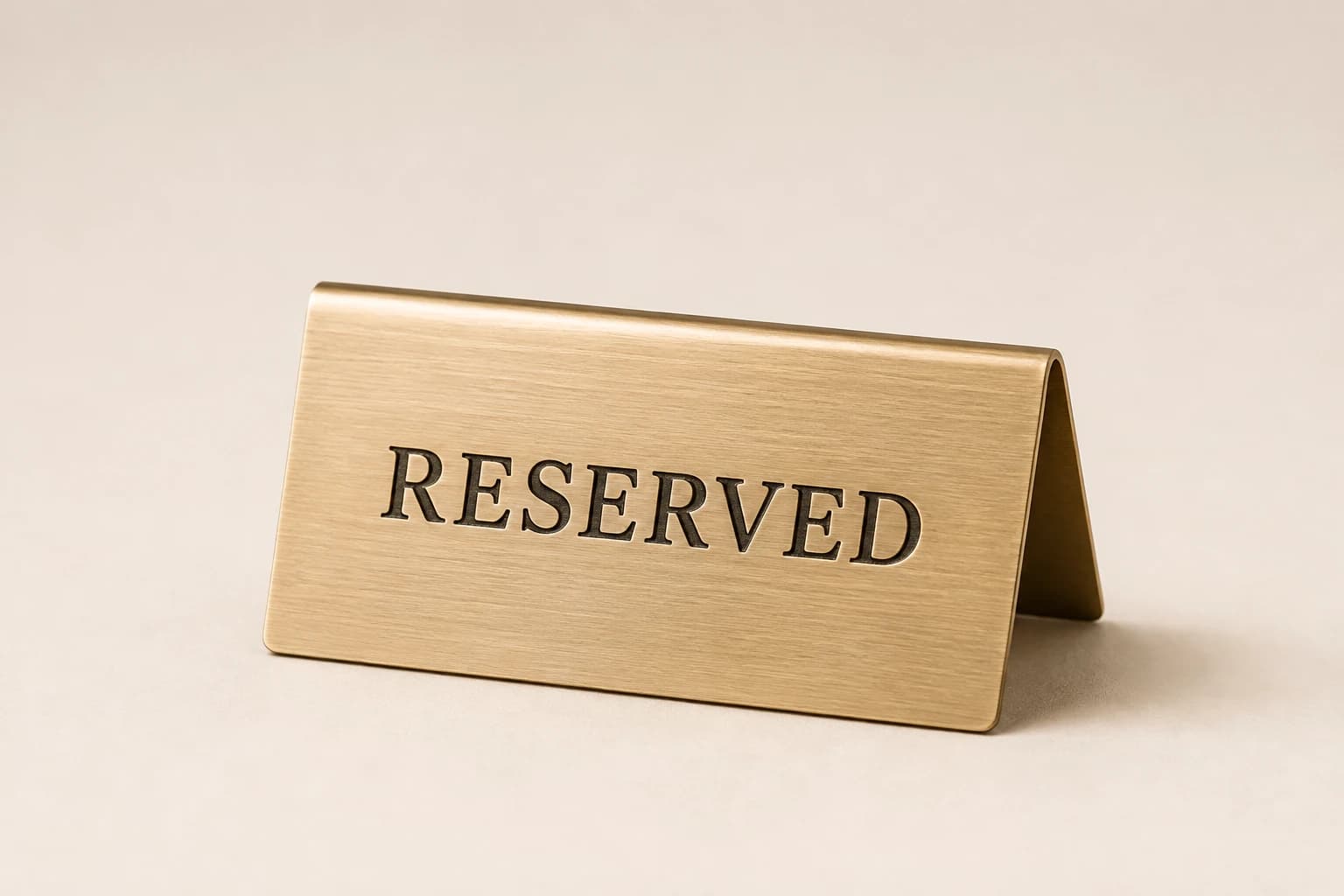
Keep the restaurant identity permanent and give changing event instructions a defined, separate space. Choose a replaceable insert only when someone can access it, make a correctly sized replacement and return the display to its normal message. The update method should be shown before the support or frame is approved.
List the actual messages the host will switch between: normal check-in, private-event entrance or a temporary direction to another desk. A removable card may suit those short changes without requiring the restaurant logo to be reprinted. Keep a normal-service master alongside the event version so a temporary instruction does not become the accidental default.
Test the replacement action from the host’s side. A top-loading slot can require space above the frame; a side opening can require clearance beside it. These are questions for the proposed hardware, not assumptions about all holders. Ask for an insert template with its orientation and visible area, and make one sample insert before ordering additional printed sets.
Illustrative example: how would two host stations select their displays?
In this illustrative restaurant brief, the main entrance has a host counter while a separate event room needs its own welcome point. The buyer selects one countertop assembly for the counter and one floor assembly for the event entrance. Both carry the same restaurant name, but their supports and changing messages differ.
The fictional countertop has a designated display rectangle of 260 by 180 millimeters. Candidate A’s proposed base is 220 by 140 millimeters, leaving 40 millimeters in each overall dimension within that rectangle. That subtraction compares footprints only; it does not establish stability, clearance or guest readability. The venue still reviews the assembled mockup at the actual station.
The event display uses a separate proposed base drawing rather than reusing the countertop measurement. Its replaceable insert says Private Event Check-In; the permanent face carries the restaurant name. The purchase is two complete sign assemblies: one plus one equals two. Insert artwork versions are recorded in a separate worksheet column and are not counted as extra physical signs in the optional quantity check.
Use the article’s example files
The first two rows are illustrative display proposals. Use the blank project row to record your own support, footprint and insert access; sample dimensions are not product specifications.
What should you inspect on a host-sign sample?
Inspect a host-sign sample as an assembled object at its proposed position. Check the visible message, base footprint, reverse view and method of changing inserts. Include the proposed face finish and actual cleaning instructions in that review. A flat artwork proof can settle wording while leaving these physical questions unanswered.
Look from the guest approach, from the host’s seat and from the side visible to people waiting nearby. A double-sided display needs a deliberate reverse layout; a one-sided panel may need a finished back even though no second message is printed. Ask the quote to distinguish a finished reverse from a second decorated face.
Record observations rather than broad approval labels. Write that the base fits the reserved rectangle, that the insert clears the shelf above it or that the pale lettering needs a different background. If the sample changes, identify the changed component and repeat the affected check. Retain the selected finish reference with the final drawing so a later replacement request describes the actual object.
What belongs in a host-stand sign quote request?
Send the host-station photograph, measured display area, preferred support and final welcome message with the quote request. Ask for separate identification of the complete assembly, printed inserts and any optional alternate face. The response should state the proposed construction and what the restaurant must supply before the display can be made.
For Table Number Co worldwide enquiries, include the destination country and the date the display is needed for use, then request a project-specific production and delivery proposal. A competitor’s advertised dispatch window does not establish the schedule for your construction. If a sample is needed, make that review step visible before committing the opening date to an order assumption.
Resolve the support before polishing small decorative details. The buying brief is ready when the maker and venue are discussing the same countertop or floor object, the same visible area and the same update method. Keep the annotated placement sketch with the approved face proof so the finished welcome message has a defined place to do its job.
How do countertop, floor and wall displays compare?
Countertop, floor and wall displays solve different support problems at a restaurant entrance. Compare the space they occupy, the way graphics change and the approvals each installation needs. Select the format that places the welcome instruction at the intended decision point, then specify the face material within that construction.
| Option | Countertop assembly | Floor assembly | Wall-mounted display |
|---|---|---|---|
| Occupied space | Needs an assembled base footprint within the host work area; measure depth as well as width. | Needs a separate venue-approved base location; its artwork width does not describe its floor footprint. | Uses a selected wall area; confirm the surface and mounting proposal with the responsible installer. |
| Changing information | A small removable insert can keep temporary instructions beside permanent identity. | A framed poster or insert can carry an event message; confirm how it opens at the installed height. | Check whether the face changes in place or must be removed from its mounting. |
| Reverse appearance | The back may face the host or guests beyond the desk; specify the intended finish. | The reverse can be visible from another approach; approve a second message only when useful. | The back is usually part of the mounting relationship rather than a guest-facing message. |
| Quote boundary | Ask whether the printed face and base arrive as one complete item. | Identify pole, base, frame and graphic inclusions individually within the assembly description. | Separate the sign specification from site installation work and any wall preparation. |
What else should you ask before buying a host-stand sign?
A host-stand sign order is ready for pricing when its support, face and update method are defined. The remaining questions concern what is included and how the venue will use the object. Keep the answers attached to the selected construction so a decorative revision does not silently change the purchase.
What affects the cost and timing of a host-stand sign?
The quoted unit should be a complete display with its included support and decoration identified. Size, face material, base or frame construction, printed inserts, sample review and destination can change the proposal. Ask Table Number Co for the actual project price and schedule after those choices are defined; an artwork-only approval does not confirm assembly or delivery timing.
Can I buy only a replacement welcome panel?
Request a panel-only quote with the existing holder dimensions, opening method and a photograph of its retention detail. Give the visible area separately from the full insert size. The maker must confirm compatibility with that particular holder; matching the front artwork size alone does not show that the new panel will fit.
Does clear acrylic mean the logo has no background?
No. A clear substrate can be combined with printed backing, an opaque logo area or a separate backer, depending on the proposed process. Ask the proof to show those layers and review a relevant sample. Specify what should remain transparent instead of relying on the word clear to describe every part of the finished design.
Should both sides say the same thing?
Use the same message on both sides only if both approaches lead guests to the same action. A reverse face may instead need a different instruction or simply a finished appearance. Record front and reverse separately in the brief, and ask whether a second decorated face changes the quoted construction or artwork scope.
Can the sign stay in place during cleaning?
Ask for care instructions for the exact face, decoration and support, then have the restaurant review them against its cleaning routine. The answer can differ between a fixed display and a removable insert assembly. Do not assume the counter’s cleaning product is also suitable for the sign or that a lens seals the graphic against liquid.
Sources and scope
The sources below support the cited technical details. The ordering workflows are editorial recommendations. Your project specification, price and schedule are established in the written quote and approved proof.
- Displays2Go: Telescoping Sign Holder with Adjustable Pole and Steel Base · checked 2026-09-05
Which buying guide should you read next?
All buying guidesChoose the menu display by the guest action, content-change responsibility and real table test, then count physical assemblies separately from printed faces and online destinations.
Try the proposed menu sign in its real table position, with normal lighting and place settings. Check the message, scan and destination as one guest journey.